
New Dog Hemangiosarcoma Study
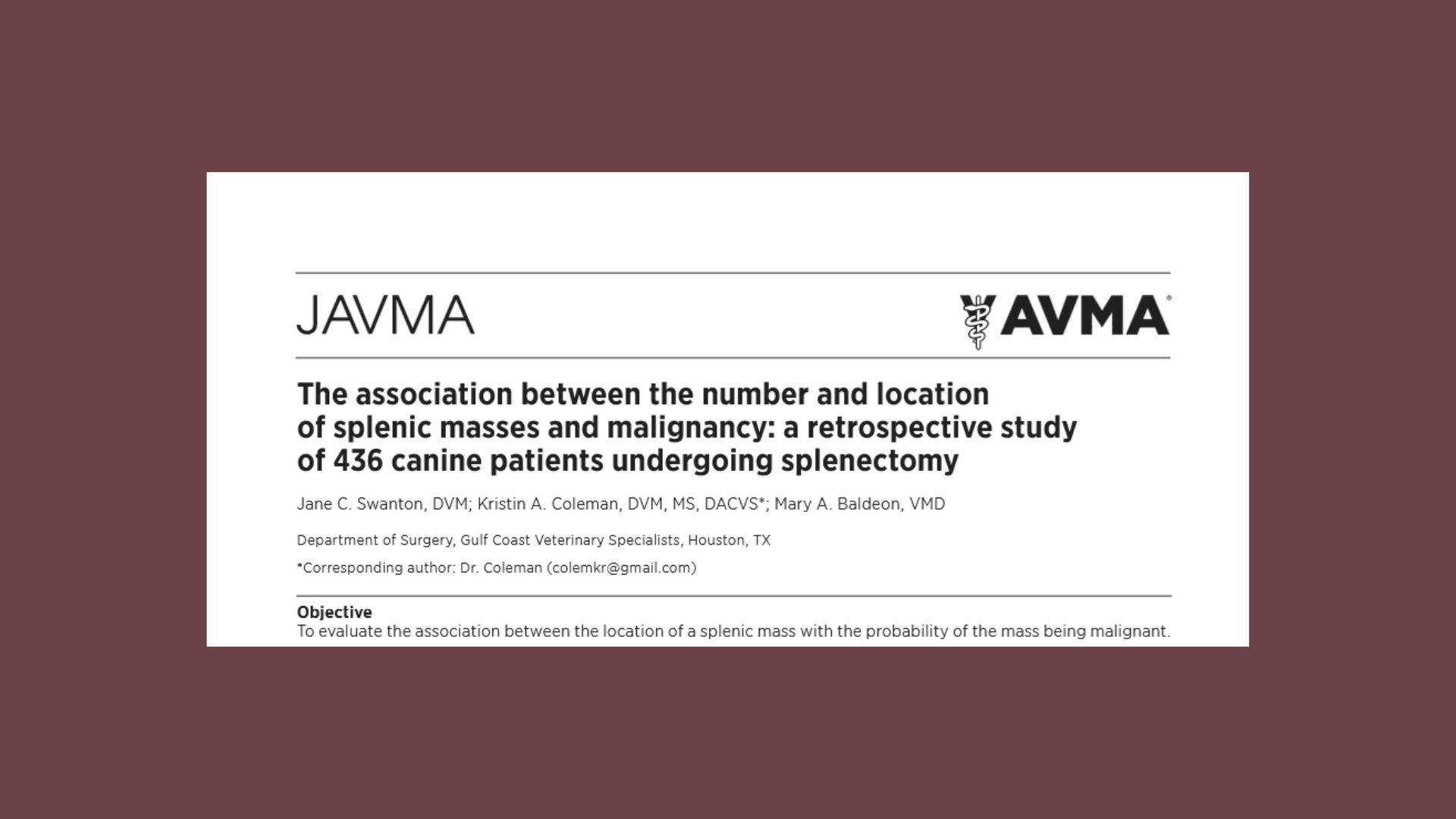
Grateful to Dr. Sue Cancer Vet for alerting everyone to this new dog hemangiosarcoma study via her great social media videos. I dug around to find the full paper. I read it at the very beginning of the recent 4-day power outage, thinking how heroically productive I was being despite work limitations. I’m just going to hit a few of the main points, but basically this paper looked at possible associations between the number and location of splenic masses or lesions in dogs and them ultimately being diagnosed with cancer. In all the cases, looked at retrospectively, the dogs had their spleens removed (splenectomy) and follow-up pathology to figure out what was what.
TL/DR Results
“This study did not find any association between the location of the splenic mass and malignancy; however, it found that there is a significant association between malignancy and splenic masses documented in multiple locations, which was previously reported to have no association with malignancy.”
Dog Hemangiosarcoma Study Basics
- Case reviews of 436 client-owned dogs (ages 4 to 16 years old) who had their spleens removed between July 1, 2018, and August 9, 2024.
- The dogs represented 81 breeds.
- 39.2% received a malignant diagnosis / cancer diagnosis — not just the most common hemangiosarcoma (120) but also other cancerous diagnoses, including spindle cell sarcoma (6) and lymphoma (1)
- The study did NOT distinguish if the multiple splenic masses were primary cancers or intraorgan metastisis.
- 60.7% received a benign diagnosis — most common was nodular lymphoid hyperplasia
Multiple Splenic Masses More Likely to be Cancer
“The odds of a malignant diagnosis were 1.6 times higher (95% CI, 1.1 to 2.5) when there were masses in multiple locations compared to a single location in the spleen.”
Why Does This Matter?
I admit that I’m quick to assume that any mass or lesion on a dog’s spleen is hemangiosarcoma. Having lost our Lab-mix Cody to it many years ago resulted in some serious PTSD around this type of cancer with incredibly poor prognoses.
So, the idea that you might be able to make better surgical and other treatment decisions for dogs based on how many masses seems useful to me.
What About Diagnostic Imaging for Spleen Masses in Dogs?
While this study went based on post-op pathology reports for the benign or malignant diagnoses, meaning all the dogs did indeed go through surgery, it did not look at pre-op diagnostic imaging specifically as a working factor. The Discussion section of the published study explains what’s currently known about the role of ultrasound, CT scans, and even MRIs in pre-op assessments of dogs with spleen troubles.
In most cases ultrasound often can determine if there are multiple masses or lesions on the spleen, but it cannot determine if they are benign or cancerous.
CT scans with contrast may show differences between benign or cancerous masses or lesions … “that may provide greater insight for owner’s decision-making.”
None of the dogs in this study had an MRI. However, another, much smaller study (just 8 dogs) did report that …”These results suggest that MRI is a useful modality for abdominal imaging in veterinary patients, and MRI accurately differentiated benign from malignant focal hepatic and splenic lesions in this sample of patients.”
However, the study we’re talking about here points out that the use of advanced diagnostic imaging … “is often restricted by cost and availability.”
In many cases, I suspect dog lovers will simply opt for a splenectomy surgery, if the dog is healthy enough otherwise to survive the surgery.