
Busting the Myth – Dogs Do Not Wander Off to Die
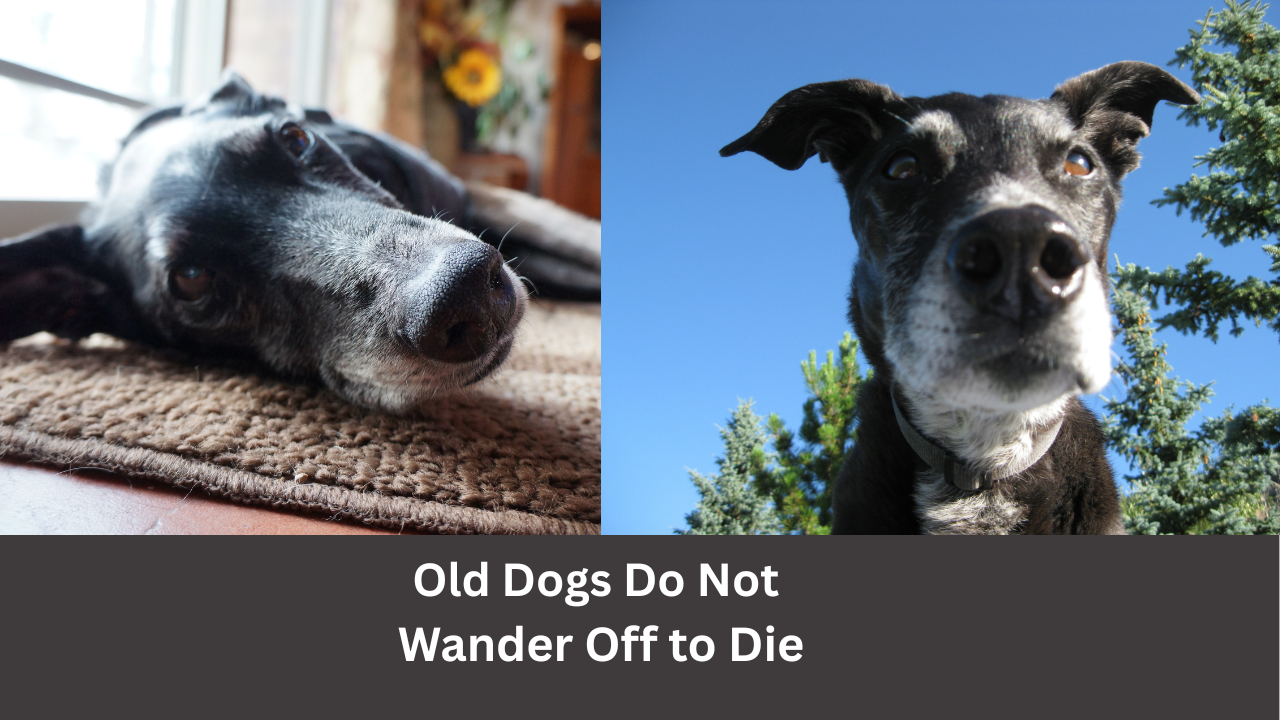
As much as I enjoy having social media feeds full of dogs, cats, and other animals (Jimothy anyone?), sometimes I come across things that make me furious. This week … it’s a local lost dog post for a really, really, really old Labrador Retriever. Ultimately, his body was found. His body. The original poster / dog’s family trotted out a huge myth. So, let’s be clear — Dogs do NOT wander off to die. The dog wandered off (due to poor supervision) and then died. It wasn’t intentional by the dog. It was human error and, I think, procrastination of making the decision to euthanize.
Perhaps I’m extra sensitive to this topic since we adopted the very Old Man Dog in November, and I often have to look carefully to be sure he’s still breathing. He’s mostly deaf, so he sleeps like the dead. Let’s break down what’s really happening in these situations.
Yes, I Checked
I was pretty sure this myth was indeed total baloney, but being me … I looked it up and found confirmation about the reality of these scenarios. A veterinarian wrote this similar rant in 2014.
Wendy Smith Wilson, DVM, wrote in part… “I am going to rain on that parade. Plainly and simply: animals that are old, sick and debilitated are already suffering and in need of care to mitigate their discomfort, in whatever form that has come. While the notion that they drift away to die peacefully is quite romantic, I submit that instead they wander off and are unable to return. Perhaps they stumble over a hillside or into a creek and are physically unable to get out. Perhaps they become disoriented (as senior citizens are often known to do) and cannot find their way home, instead traveling aimlessly looking for a safe haven.”
She goes on to say that really old dogs require as much supervision and as puppies. That means secure fencing, leashes, and constant supervision outside and regular checks inside.
Our Old Man Dog, for example, likely has a long history of being an escape artist. Good Samaritans brought him to the shelter or called animal control countless times, after finding him collapsed in public. Every once in a while, when he’s feeling extra good, he will test physical barriers we put up to keep him safe. A couple times recently, I’ve left him alone outside for just a bit and come back to find him in dire straits — such as having fallen and gotten stuck under a patio chair. So, we have to be really careful. After all he has been through, he deserves to be safe.
Myths Built into Myths
I also found this site with a detailed article about terminal behaviors in animals. Spoiler alert — different types of animals behave in different ways when sick or dying.
It reads in part …”Here’s where it gets interesting: two long-standing assumptions about terminal behavior don’t hold up well under scrutiny.
The first is that animals reliably ‘know’ death is coming and withdraw to face it alone. The second is that all species handle the end the same way. Neither is true, and the exceptions are what make this field worth paying attention to.”
That article goes into some details about elephants and chimpanzees and the types of behaviors that have been observed when a member of the group is sick, dying, or had died.
Then, it says this: “Dogs and cats almost certainly don’t have an abstract concept of mortality the way humans do. What they likely experience is something more physical and immediate, a felt sense that something in their body is deeply wrong, which then drives the behavioral changes we interpret as ‘knowing.'”
Hiding Out of Instinct or Getting Clingy
That article explains dog behavior like this … “Dogs hide before death primarily because feeling vulnerable triggers an old survival instinct, one inherited from wild canine ancestors who avoided exposing weakness to predators or rival pack members. It’s less ‘I know I’m dying’ and more ‘I feel terrible and unsafe, so I need cover.'”
But, that’s not true for all dogs, so personality really matters. Some dogs, the article says, will become clingier as they decline. So, it depends on the dog and the details of each situation.
Sometimes, for example, the Old Man Dog seems agitated and calms down if one of us goes and sits with him. Other times, he gets up and leaves if I try to hang out with him.
What Else Caught My Eye
That neuro-based article on terminal behaviors also features a chart that lists signs of animals dying (divided by species, if you want to take a look) that caught my attention because it includes things we’re seeing at times in our Old Man Dog.
- Eating less over time
- Spending time in “safe” corners
- Changes in breathing (struggling, irregular, audible)
- Weakness in hind quarters
- Feet feeling cold to the touch
Canine Hospice Mindset
Since we’re basically a hospice home for our Old Man Dog (whose name and photos I do not share because he comes from a sketchy situation), I think about these things a lot.
I think about our prior very old boy, Ginko, who made it 4 months shy of his 16th birthday. He had a few health issues — none of them terminal per se. But, he just started to fail in general, so we scheduled a time for our veterinarian to come to the house, and we let him go. She agreed it was time. I took the photo on the left of the header just before we let him go. He’d just had bacon and eggs for breakfast, and we were resting and waiting for our veterinarian to arrive.
Ginko’s main troubles became:
- Droopy hind end
- Significant weight loss — just from the strain of being alive, I think
- Total incontinence
For comparison, the Old Man Dog is increasingly frail and wobbly. We haven’t seen him get the zoomies in many months. He does sometimes like to “run” with me a few strides, but that’s becoming more rare as well.
He is still eating, but he often needs us to hand feed him a bit, then hold his bowl while he lies down and eats the rest himself. Or, we help him stand up long enough to eat from his raised feeder, if he prefers that on a given day.
Potty accidents (especially poop) are a daily thing. He even poops in his sleep, which is kind of hilarious.
The first few times he slept until 10 am, we had a hard time waking him up, and his rear feet felt cold. Once he’s up, he is up and seems like a content, good-good boy, but that first bit of waking him up can feel like … this … is … it.
I will say that the smoky air from wildfires and the extreme heat this summer is likely taking a toll on him. Really on all of us. We have never needed a/c at our high-altitude house, but this summer has been tough so far. We’ve had the highest temps we’ve ever seen (since we moved here in 2001) in the last week, and not just 1 day, but many, many days in a row.
So, there’s a chance he will perk up again when the weather cools down. Or, there’s a chance he won’t make it much longer, which is hard to write out loud. I like to think we will be brave enough to let him go — and not risk him dying on his own. Each morning, though, I do look to be sure he’s breathing.