
Canine Cognitive Decline Guidelines
When I saw the headline that an international working group recently published canine cognitive decline guidelines, I thought — “perfect timing” — since we adopted a very old, frail, and often confused dog a while back + our other dogs are getting older too. When I read that the guidelines included a diagnostic flowchart, I got super excited. Except, now that I’ve read the paper and looked at the flowchart, it’s not as helpful (to me personally) as I’d hoped. That said, it includes good info about behavior changes to monitor and how to rank their severity over time. Toward the end, I include details and accommodations we’ve made for the Old Man Dog.
Suggested Diagnostics Not Super Practical
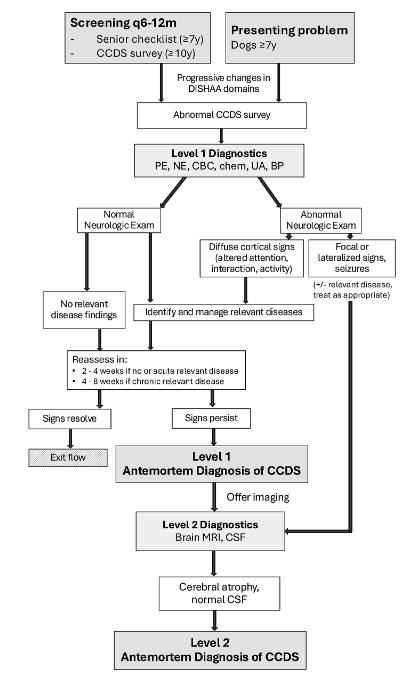
I fear the suggested diagnostics for canine cognitive decline are not super practical for most people. The paper discusses families completing surveys to rate common canine cognitive decline symptoms. That seems reasonable, right? It also suggests a collection of common urinalysis and blood work tests to find or rule out other diseases or conditions. That seems fine too. And, it recommends veterinarians do complete neurological exams. No problem there either.
BUT, to know what’s what for sure, it suggests testing cerebrospinal fluid (CSF) and doing a brain MRI. That’s where the recommendations fall apart, I think, for the vast majority of dog lovers.
I say that as someone who has been through these tests (twice!) with our original canine heroine. They were stressful and costly back then in 2012. Now, with the skyrocketing costs of veterinary care? I suspect it’s prohibitively expensive for most people, especially those with older dogs who may have had to ditch pet insurance due to rising premium costs (also like me).
Here’s the flowchart, so you can see what you think.
What to Look for in Older Dogs
All that said, the guidelines include helpful information on the types of behavior changes you might see in an older dog suffering from cognitive decline — the official term is Canine Cognitive Dysfunction Syndrome (CCDS).
- Disorientation
- Impaired social interactions
- Sleep disturbances
- House soiling, learning, and memory deficits
- Activity changes (increased or decreased)
- Anxiety and fear (increased)
The paper explains that other studies suggest that, “nighttime restlessness, decreased daytime activity, and changes in social interaction occur early in the disease, while house soiling and spatial disorientation are seen as disease severity increases.”
Severity Levels
Let’s also look at the 3 levels of canine cognitive decline severity outlined in the paper.
- Mild, with the dog still mostly able to handle daily activities.
- Moderate, where families need to institute management strategies and to adapt the dog’s environment.
- Severe, where ” behavioral changes are overt and debilitating; the dog needs support even for basic functions, and comprehensive management is needed.”
How This Plays Out For Us
Our Old Man Dog often has potty accidents (mostly poop), especially in the morning if we don’t get to him fast enough. He wanders the house, especially after dinner, but also during the day. He barks for no reason, especially later in the evenings. He often seems confused and just stares. Granted, he’s deaf, which is an age thing too, so it is not easy to get his attention. His body isn’t as strong as it likely once was, making him frail. He can walk pretty well, but he does fall down if he tries to go too fast. He also finds the tile floors too slippery, and he often needs help getting up the 2 steps at our doors to the outside. When he stands still, his hind end droops. He gets tired pretty easily, so we don’t walk too far on the days that we do walk.
Our Accommodations, So Far
So far, our accommodations include the following strategies:
- Adding fish oil, joint supplements, and twice-daily pain meds
- Staying up later and getting up early most days in hopes of preventing potty accidents
- Taking him outside to potty like we would if house training a puppy (Every successful trip outside, especially in the winter weather, is a big victory.)
- Adding rubber-backed mats and other area rugs to help with his footing in the house
- Holding him up so that he can eat his meals, if needed
I also signed up for several online webinars, workshops, and even a 6-week class on senior dog topics. I’m practicing the strategies with Clover before I even think about doing them with the Old Man Dog. I learned about a couple of supplements that we’re trying too. The first one, for senile dogs, gave him horrible diarrhea, so that’s a no-go. We just started one this week that might help him maintain some muscle. We will see if it helps. We’re talking about switching him to the senior dog food we gave our last very old boy, but (like everything else) it’s now super, super expensive.
The bottom line is that we’re doing our best for the Old Man Dog. He sleeps a lot, but he also smiles a lot. And, a couple times a week he gets the zoomies, which is the most joyful and sweetest thing to see — even if he’s a little extra sore and wobbly later. I hope he feels safe and content. I hope those little moments of 100% joy are enough.